|
Revista Ciencias de la Actividad Física UCM. N° 26(2), julio-diciembre,
2025. ISSN: 0719-4013
|

|
| Artículo Investigación
A new complementary HIIT program with nage-kome in under-18 judo athletes: Pilot Study
Un nuevo programa complementario de HIIT con nage-kome en judokas sub-18: Estudio Piloto
Um novo programa complementar de HIIT com nage-kome em atletas de judô sub-18: Estudo Piloto
Da Silveira-Goya, Giovanni H.1;
Andrade-Machado, Fabiana2;
Fontes-Zanco, Maria E.3 &
Segabinazi-Peserico, Cecília4

Da Silveira-Goya, G.H., Andrade-Machado, F., Fontes-Zanco, M.E., &
Segabinazi-Peserico, C. (2025). A new complementary HIIT program with
nage-komi in under-18 judo athletes: Pilot Study. Revista Ciencias de
la Actividad Física UCM, 26(2), 180-192.
http://doi.org/10.29035/rcaf.26.2.12
ABSTRACT This study
aimed to determine the effects of four weeks of complementary high
intensity interval training (HIIT) sessions (3 weeks of intensified
training load (TL) followed by 1 week with reduced TL) on physical
performance, internal training load (ITL), stress tolerance (ST),
recovery state, and well-being in under-18 judo athletes. Eight
under-18 male judo athletes (15.4 ± 0.9 years) were evaluated before
and after four weeks of a training period, with the following tests:
countermovement jump (CMJ), Special Judo Fitness Test (SJFT), Uchi-Komi
Speed Test (UST), and Judogi Chin-Up Test (JCT). Well-being and
recovery state were evaluated before, and ITL after each training
session, and ST at the end of each training week. The training program
consisted of four weeks of a judo regular training routine with
specific judo techniques, performed three times per week, added to the
HIIT complementary training sessions with the nage-komi modality,
performed twice a week. There was a significant improvement in the
performance of the UST (18.5±2.2 vs. 24.7±2.2 reps) with a large effect
size (ES) and a reduction in heart rate one minute after the SJFT
(150±9.1 vs. 139±8.0 bpm; large ES) post-training. For ITL, a
significant decrease was observed from week 3 to week 4. Therefore, the
training period with HIIT led to positive improvements in judo
athletes' performance, particularly in the UST, and in the recovery
state, as assessed by heart rate (HR) one minute after the completion
of the SJFT. In terms of practical applications, it is suggested that
HIIT combined with nage-komi could be incorporated into judo training
programs to enhance performance.
Key words:
Combat sports; Young Judokas; Athletic performance; Monitoring training.
1 Universidade Estadual de Maringá, Departamento
de Educação Física, Grupo de Estudos e Pesquisa em Fisiologia do
Exercício Aplicada a Humanos, Brasil.
https://orcid.org/0009-0007-4113-7950, ra117768@uem.br 2 Universidade Estadual de Maringá, Departamento de Educação Física e Programa de Pós-Graduação associado em Educação Física UEM/UEL, Grupo de Estudos e Pesquisa em Fisiologia do Exercício Aplicada a Humanos, Brasil. https://orcid.org/0000-0003-2235-577X, famachado_uem@hotmail.com 3 Universidade Estadual de Maringá, Departamento de Educação Física, Grupo de Estudos e Pesquisa em Fisiologia do Exercício Aplicada a Humanos, Brasil. https://orcid.org/0009-0004-2304-8848, ra124436@uem.br 4 Universidade Estadual de Maringá, Departamento de Educação Física, Grupo de Estudos e Pesquisa em Fisiologia do Exercício Aplicada a Humanos, Brasil. https://orcid.org/0000-0002-2647-1850, ceciliapeserico@gmail.com RESUMEN
Este estudio tuvo como objetivo determinar los efectos de cuatro
semanas de sesiones complementarias de high intensity Interval training
(HIIT) (3 semanas de carga de entrenamiento intensificada (CE) seguidas
de 1 semana con CE reducida) en el rendimiento físico, la carga interna
de entrenamiento interna (CIE), la tolerancia al estrés (TE), el estado
de recuperación y el bienestar en atletas de judo menores de 18 años.
Ocho atletas de judo masculinos menores de 18 años (15,4 ± 0,9 años)
fueron evaluados antes y después de cuatro semanas de un período de
entrenamiento, con las siguientes pruebas: salto con contramovimiento
(CMJ), Special Judo Fitness Test (SJFT), Uchi-Komi Speed Test (UST) y
Judogi Chin-Up Test (JCT). El bienestar y el estado de recuperación se
evaluaron antes, e la CIE después de cada sesión de entrenamiento, y TE
al final de cada semana de entrenamiento. El programa de entrenamiento
consistió en cuatro semanas de una rutina de entrenamiento regular de
judo con técnicas específicas de judo, realizadas tres veces por
semana, agregadas a las sesiones de entrenamiento complementares de
HIIT con la modalidad nage-komi, realizadas dos veces por semana. Se
observó una mejora significativa en el rendimiento del UST (18,5 ± 2,2
frente a 24,7 ± 2,2 repeticiones) con un gran tamaño de efecto (TE) y
una reducción de la frecuencia cardíaca un minuto después del SJFT (150
± 9,1 frente a 139 ± 8,0 bpm; TE grande) después del entrenamiento. En
el caso de la CIE, se observó una disminución significativa entre la
semana 3 y la 4. Por lo tanto, el entrenamiento con HIIT produjo
mejoras positivas en el rendimiento de los judokas, especialmente en el
UST, y en el estado de recuperación, evaluado mediante la frecuencia
cardiaca (FC) un minuto después de completar el SJFT. En cuanto a las
aplicaciones prácticas, se sugiere que el HIIT combinado con nage-komi
podría incorporarse en los programas de entrenamiento de judo para
mejorar el rendimiento.
Palabras clave: Deportes de combate; Jóvenes Judocas; Rendimiento atlético; Monitoreo del entrenamiento. RESUMO Este estudo
teve como objetivo determinar os efeitos de quatro semanas de sessões
complementares de high intensity Interval training (HIIT) (3 semanas de
carga de treinamento (CT) intensificadas seguidas de 1 semana de CT
reduzida) sobre o desempenho físico, carga interna de treinamento
(CIT), tolerância ao estresse (TE), estado de recuperação e bem-estar
em atletas de judô menores de 18 anos. Oito atletas de judô do sexo
masculino menores de 18 anos (15,4 ± 0,9 anos) foram avaliados antes e
após um período de treinamento de quatro semanas com os seguintes
testes: salto com contramovimento (CMJ), Special Judo Fitness Test
(SJFT), Uchi-Komi Speed Test (UST) e Judogi Chin-Up Test (JCT). O
bem-estar e o estado de recuperação foram avaliados antes e após cada
sessão de treinamento, e a CIT ao final de cada semana de treinamento.
O programa de treinamento consistiu em quatro semanas de uma rotina
regular de treinamento de judô com técnicas específicas de judô,
realizadas três vezes por semana, além de sessões complementares de
treinamento de HIIT utilizando a modalidade nage-komi, realizadas duas
vezes por semana. Uma melhora significativa no desempenho do UST (18,5
± 2,2 vs. 24,7 ± 2,2 repetições) com tamanho do efeito (TE) grande e
uma redução na frequência cardíaca (FC) um minuto após o SJFT (150 ±
9,1 vs. 139 ± 8,0 bpm; TE grande) foram observadas após o treinamento.
Na CIT, uma diminuição significativa foi observada entre as semanas 3 e
4. Portanto, o treinamento HIIT produziu melhorias positivas no
desempenho dos judocas, especialmente no UST, e no estado de
recuperação, avaliado pela frequência cardíaca (FC) um minuto após a
conclusão do SJFT. Em termos de aplicações práticas, sugere-se que o
HIIT combinado com o nage-komi poderia ser incorporado aos programas de
treinamento de judô para melhorar o desempenho.
Palavras chave:
Esportes de combate; Judocas jovens; Desempenho atlético; Monitoramento do treinamento.
INTRODUCTION Judo is a
combat sport characterized by high-intensity actions, requiring complex
skill and tactical developments for success in competitions. Aerobic
metabolism predominantly supplies energy throughout the 4-min judo
fight and anaerobic metabolism is used to execute techniques with
strength and power, in addition to the defending actions of the
opponents (da Silva et al., 2021; Franchini et al., 2014; Julio et al.,
2017). In judo training programs, sessions focused on modality-specific
exercises combined with complementary physical training, such as
running, cycling, and/or strength training (Agostinho et al., 2015;
Bonato et al., 2015; Marques et al., 2017).
In judo training programs, sessions focused on modality-specific exercises are combined with complementary physical training, such as running. Among complementary physical training programs, high intensity interval training (HIIT), which is characterized as a high-intensity and short-duration training modality (Laursen & Bucheit, 2019), has been used as a strategy with judo athletes to improve muscular strength, as well as aerobic and anaerobic performance (Magnani Branco et al., 2017; Ouergui et al., 2022; Ouergui et al., 2020). Considering HIIT as a complementary strategy to judo training, some studies used cycle ergometer and running training sessions (Magnani Branco et al., 2017; Franchini et al., 2016), however, given the need for modality specificity, other studies have applied HIIT using specific judo exercises, such as randori (grip competition without throwing), uchi-komi (repeated entries of the technique), and kumi-kata (grip competition with a partner without throwing) (Ouergui et al., 2022; Ouergui et al., 2020). Although effective, HIIT programs impose a heavy internal training load (ITL), which needs careful and individual monitoring to obtain information on how athletes are responding to different training stimuli. Considering this, the session rating of perceived exertion (sRPE), represents a practical and valid method for ITL quantification, that has been used to monitor judo athletes during training sessions (Magnani Branco et al., 2017; Ouergui et al., 2020). Together with the sRPE, self-report scales and questionnaires are used to determine stress tolerance, recovery state, and well-being of athletes in relation to the TL imposed during training (Ouergui et al., 2020). Furthermore, it is important to mention that a period of intensified training with HIIT generally induces neuromuscular, physiological, and hormonal responses that lead to changes in the ITL, well-being, and recovery states of athletes. Thus, a period with a reduced TL (i.e., tapering) is frequently used as a strategy for physical and mental restoration (Araujo et al., 2022; Ouergui et al., 2022; Papacosta et al., 2013). Specifically, there is limited research on the effects of judo-specific HIIT sessions as a complementary training method to enhance performance (Magnani Branco et al., 2017; Ouergui et al., 2022; Ouergui et al., 2020). For example, Ouergui et al. (2020) investigated the effects of HIIT followed by a tapering period using different judo exercise modalities (e.g., kumi-kata group [KG], uchi-komi group [UG], and running group [RG]), and found that the KG led to significant improvements in vertical jump performance, and in isometric and dynamic judogi chin-ups, compared to the UG, RG, and CG. Additionally, the UG demonstrated better performance in the Uchi-Komi Speed Test compared to the RG and CG. The study by Magnani Branco et al. (2017), which aimed to investigate the effects of 4 weeks of training with three different HIIT modalities (lower and upper body cycle-ergometer and Uchi-Komi), demonstrated no differences in ITL, psychometric questionnaires and hormone levels between groups. However, no previous studies have structured a complementary HIIT training program using modality-specific nage-komi exercises (execution of the techniques), combining a TL intensification period followed by a reduced TL period. The present study proposes a new complementary HIIT program that differs from previous studies (Magnani Branco et al., 2017; Ouergui et al., 2022; Ouergui et al., 2020) mainly because the nake-komi exercises were the modality-specific used during the complementary sessions, and the strategy for the periodization was the combination between intensified plus reduced TL during the training program. Thus, this study aimed to determine the effects of four weeks of complementary HIIT sessions (3 weeks of intensified training followed by 1week with reduced TL) on physical performance, internal training load (ITL), stress tolerance (ST), recovery state, and well-being in under-18 judo athletes. We hypothesized that athletes would present improvements in performance after the training period and that the ITL, ST, recovery and well-being would be different between the training phases. METHODS Participants Eight under-18
male judo athletes (age: 15.4 ± 0.9 years, stature: 170.0 ± 0.1 cm,
body mass: 65.7 ± 12.7 kg, and fat percentage: 14.4 ± 4.3%), competing
at state level, participated in this study. The athletes were recruited
from two different training sites in the same city, each comprised of
judo athletes who met the inclusion criteria; after recruitment, all
athletes completed the training period together at the same site. The
inclusion criteria were (a) having all “no” responses on the Physical
Activity Readiness Questionnaire (PAR-Q); (b) having a minimum of three
years of experience in judo training; (c) being at least a green belt
or higher; (d) training at least three times a week; (e) participating
in stage-level competitions in the previous year; (f) not being
diabetic, hypertensive, or having any cardiovascular or respiratory
disorders, and (g) not having suffered any injury in the previous six
months. The exclusion criteria were being injured during the training
protocol, not performing all the HIIT complementary sessions, and not
achieving a 75% frequency in regular judo training.
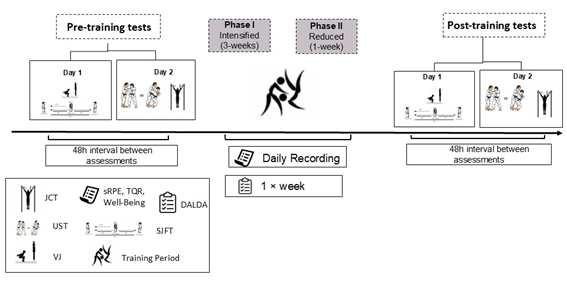
Prior to testing, all procedures and test protocols were explained individually to each participant and written informed consents were obtained from parents and informed assents from athletes. This study was approved by the Human Research Ethics Committee at the State University of Maringá (n°4.177.256/2020). Experimental Design The present study has a quasi-experimental design because of the absence of a control group. One week before the beginning of the experimental period the athletes were familiarized with the procedures (e.g., training exercises, scales, and questionnaire). In the first week, before the training period, they performed the following tests, with a 48h interval between trials: vertical jump test and special judo fitness test (SJFT) (day 1); uchi-komi speed test (UST) and judogi chin-up tests (JCT) (day 2). These tests were repeated after the end of the training program following the same procedures. The training program consisted of two phases: phase I made up of 3 weeks of intensified training (IT), and phase II made up of 1 week with a reduced TL. During both phases, the ITL, recovery state, and well-being of each athlete were monitored daily, and the stress tolerance (ST) was evaluated at the end of each training week. The experimental protocol is illustrated in Figure 1. Figure 1. Schematic representation of the experimental design.
Vertical jumps (VJs) The VJs were
measured using an electronic platform (Jump System Pro Cefise®, Nova
Odessa – SP, Brazil) designed to determine contact time, vertical jump
flight time, and muscle power of the lower limbs. Participants
performed the countermovement jump (CMJ), in which the athlete stood on
the mat, fully erect with his hands positioned at the waist; at the
signal of the appraiser, the athlete squatted quickly and jumped as
high as possible. The warm-up consisted of 10 min of running on a
treadmill at low intensity, with an RPE between 10-12 points (Borg,
1982), followed by five submaximal CMJs for familiarization (Magnani
Branco et al., 2022). The athletes performed three VJs, with an
interval of 30 s between repetitions, and the highest values obtained
for height (cm) and relative power (W/kg) were used as the performance
variables (Nuzzo et al., 2008; Petridis et al., 2019).
Special Judo Fitness Test (SJFT) The SJFT is a
test with intermittent judo actions characterizing a measure of
physical performance in judoka athletes (Sterkowicz et al.,1999;
Sterkowicz-Przybycień et al., 2019), with ippon-seoi-nage projections
in pairs with similar body mass and height: one tori (apply the
technique) and two ukes (receive the technique). The test was separated
into 3 blocks: A = 15 seconds, B and C = 30 seconds, with 10 seconds of
passive rest between the blocks. The uke remained 6 meters apart, and
tori remained in the center. The number of throws per block was
counted: A + B + C. Furthermore, during and after the test, and the
heart rate (HR) of the tori was monitored (Polar® RS800sd, Kempele,
Finland). The HR recovery (SJFT HRrecovery) was obtained by the
difference between the final HR recorded immediately at the end of the
test and the HR measured one minute after the end of the test. Data
obtained in the test were imputed in the following equation to obtain
the SJFT index: SJTF index = Final HR + HR 1 minute after the test at
rest / Total number of throws in 3 blocks. It is important to mention
that a lower SJFT index indicates better performance (Sterkowicz et
al., 1999; Sterkowicz-Przybycień et al., 2019).
Uchi-Komi Speed Test (UST) For the UST the
athletes were instructed to repeat the ippon-seoi-nage technique as
fast and as many times as possible, without throwing, during 15 s
(Ouergui et al., 2022). The test result was the number of repetitions
performed by the athletes.
Judogi Chin-Up Test (JCT)
The athletes performed isometric and dynamic judogi chin-ups with a
15-min rest between them. For the isometric test, the athlete remained
with their elbows flexed and their chin above their hands, for as long
as possible, and the total time was recorded. For the dynamic test, the
athlete was suspended and gripped the judogi. They were requested to
complete an extension and flexion, crossing their chin to above the
bar, and repetitions of completed exercises were counted. The test was
finished when the athlete could not perform the complete movement or
due to voluntary exhaustion (Franchini et al., 2011).
Training Protocol
The training program consisted of four weeks of a judo regular training
routine with specific judo techniques added to the HIIT complementary
training program, divided into two phases: 3 weeks of intensified
training (Phase I) followed by 1 week with a reduced TL (Phase II). The
regular judo training sessions were composed by the modality uchi-komi
and randori, and they were performed on Monday, Wednesday and Friday.
The complementary training sessions were performed twice a week
(Tuesday and Thursday), and consisted of an HIIT protocol with the
modality nage-komi (throwing). All sessions in the complementary
training had a warm-up with 10 series with 20 uchi-komi (repeated
entries of the technique) and different types of ukemi. The HIIT during
phase I consisted of two blocks of 6-min and 40 s (10 series x 30 s of
nage-komi with 10s passive rest). The HIIT during phase II consisted of
two blocks of 5 min (5 series x 30s of nage-komi of 30s passive rest).
The athletes were allowed a 5-min rest between sets (Franchini et al.,
2016). Table 1 presents the description of the HIIT complementary
training sessions.
Table 1. Description of the specific HIIT training program during the 4-week protocol
Internal Training Load (ITL)
The ITL was monitored and quantified using the session RPE (sRPE) with
the CR-10 scale (Foster et al., 2001). Thirty minutes after the end of
each training session, athletes answered the following question “How
was your training session?”. The ITL was calculated as the product of
session duration (minutes) and sRPE score (CR-10), and results are
expressed in arbitrary units (AU). The ITL mean and the
weekly-accumulated ITL (ITL total) was calculated intra-individually
for the analysis. From the ITL data, strain and monotony were
calculated weekly (Foster et al., 2001).
Well-Being and Recovery State
Athletes completed the well-being questionnaire (Hooper &
Mackinnon, 1995) and the total quality of recovery (TQR) scale (Kenttä
& Hassmén, 1998) 15 minutes before each training session to assess
well-being and recovery state, respectively. The mean of each week was
used for the analysis. The well-being questionnaire consists of four
factors (stress, sleep quality, fatigue, and delay onset muscle
soreness - DOMS) using a Likert scale, scored from 1-7 points, and the
sum of these factors was used to calculate the Hooper Index (HI), for
which high values indicate greater stress, fatigue, and DOMS, worse
sleep, and poor overall recovery (Hooper & Mackinnon, 1995). The
TQR scale, scored from 6-20 points was used to assess athletes’
recovery and was reflective of the responses to the preceding training
day, in which a high TQR score indicates better recovery (Kenttä &
Hassmén, 1998).
Stress Tolerance (ST) To evaluate ST,
the Portuguese version (Moreira & Cavazzoni, 2009) of the DALDA
(Rushall, 1990) was completed at the end of each training week. The
DALDA questionnaire is divided into parts A (9 questions) and B (25
questions), which represent the sources and symptoms of stress. The
possible answers to each question are “better than normal”, “normal”,
and “worse than normal”. The sum of the responses marked as “worse than
normal” on the questionnaire was recorded for analysis.
Statistical analysis
Data were analyzed using the Statistical Package for the Social
Sciences (SPSS® v.20, Inc, Chicago, IL). Data normality was verified
using the Shapiro Wilk test, that indicated the normality of all data
presented in Tables 2 and 3. The results are presented as mean ±
standard deviation (SD). To evaluate differences in performance
variables from the pre- to post-training intervention, a paired-sample
t-test was used. Additionally, the percentage change values (%) were
calculated for each variable, as the effect size (ES) to express the
magnitudes of changes between pre- and post-training (Cohen, 1988). The
threshold values for es were as follows: < 0.20 (trivial), 0.20-0.59
(small), 0.60-1.20 (moderate), and >1.20 (large) (Hopkins et al.,
2009). ANOVA for repeated measures, followed by the Bonferroni post-hoc
test was used to evaluate differences in ITL, well-being, recovery
state, and ST values across the training weeks. The level of
significance was set at P < 0.05 for all statistical analysis.
RESULTS
The comparisons between pre- and post-training for the variables
obtained during the performance tests are demonstrated in Table 2. A
significant increase was found in the number of repetitions in the UST
after the training period (P < 0.001) presenting a large ES. The
values of percentage changes indicated improvements in the JCT tests,
however with small ES. The SJFT results for pre- and post-training
demonstrated small to large ES values, with a significant reduction in
HR 1 minute after the test (HR1) (P = 0.049). Furthermore, the mean
SJFT HRrecovery was significant faster (P = 0.008) in the post-training
(46.0 ± 7.9 bpm) compared to the pre-training (29.0 ± 12.5 bpm).
Table 2. Variables obtained in the performance tests at pre- and post-training (mean ± SD)
Table 3
presents the mean and total ITL, DALDA responses “worse-than-normal”,
TQR score, and Hooper Index obtained during each of the 4 weeks of
training (HIIT sessions and judo training sessions). A significant
decrease was found for ITL from week 3 to week 4 (P < 0.001). No
significant differences were found between the training weeks for any
other variables (P > 0.05), although the responses
“worse-than-normal” demonstrated a tendency to decrease in week 4.
Table 3. Internal training load (ITL), DALDA responses “worse-than-normal”, TQR score, and Hooper index obtained during the 4-week training program (mean ± SD)
The present
study aimed to determine the effects of four weeks of complementary
HIIT sessions (3 weeks of intensified training followed by 1 week with
reduced TL) on physical performance, internal training load (ITL),
stress tolerance, recovery, and well-being in under-18 judo athletes.
The main findings were that performance in the UST and SJFT
(represented by the HR1 and HRrecovery) improved after the training
period presenting ES values classified as large, and ITL values
decreased from week 3 to week 4, partially confirming the initial
hypothesis.
Although previous studies have investigated HIIT as a complementary training strategy in judo (Magnani Branco et al., 2017; Ouergui et al., 2022; Ouergui et al., 2020), only the current study structured a HIIT training program using the nage-komi modality, combining a TL intensification followed by one week of reduced TL. Concerning the mean values and percentage variations in the performance tests, although a significant difference was only demonstrated in the UST, all results showed improvement after the training period, except for the CMJ test. Our findings regarding the CMJ are similar to previous studies with judo athletes that did not demonstrate changes in CMJ performance before training periods with complementary sessions (Magnani Branco et al., 2022; Ouergui et al., 2022). Ouergui et al. (2022) evaluated 59 adolescent male and female judo athletes (15 ± 1 years) who performed four weeks with intensified training followed by 12 days of tapering, consisting of HIIT sessions with different exercise modalities (kumi-kata, uchi-komi and running) added to the regular training program, and did not find differences in CMJ performance comparing pre- and post- training in any training groups. Magnani Branco et al. (2022) investigated the effects of a complementary strength program on physical fitness in 21 under-18 judo athletes, in which the experimental group performed the same judo training routine added to sessions of strength training for eight weeks, and did not presented improvements in the CMJ test after the period evaluated. Similarly to the present study, Ouergui et al. (2022) and Magnani Branco et al. (2022) did not apply any specific training to improve lower limb power assessed by the CMJ, which could explain the lack of changes between pre- and post-training. Unlike CMJ, in the present study the performance in the Uchi-Komi Speed Test (UST) showed significant improvements post-training, presenting a large ES for the comparison between pre- and post-training. Ouergui et al. (2022) also evaluated judo athletes using the UST test after 4-weeks of HIIT training followed by tapering and found that the uchi-komi group demonstrated better performance compared to the RG and control groups. The authors suggested that the uchi-komi and nage-komi involve specific movements in the UST, thereby enhancing athletes’ performance when incorporated into training. Concerning the isometric and dynamic strength Judogi Chip-Up Test (JCT), the present study found no significant differences and small ES in performance after the training period, although the percentage changes indicated a notable trend toward improvement. Similar to our findings, Ouergui et al. (2022) did not observe significant improvements in the JCT between pre- and post-training, but the kumi-kata group obtained higher values post-training compared to the running and control groups. It is important to mention that in both the present study and the study of Ouergui et al. (2022) the training programs did not focus on improving strength of the upper limbs, thus explaining the lack of changes in the performance of JCT. The Special Judo Fitness Test (SJFT) is one of the most commonly used test to assess physical performance in judo (Sterkowicz-Przybycień et al., 2019; Papacosta et a., 2013; Ouergui et al., 2022). In the present study, although we did not demonstrate a statistically significant improvement in the SJFT index after the training period, the ES for the comparison between pre- and post-training was moderate. In addition, the significant reduction in HR1 and faster HRrecovery after the training period, added to the large ES for this comparison, indicated a positive effect of the HIIT training on SJTF performance. Ouergui et al. (2022), after an HIIT complementary training period, found no significant difference for the SJFT index in the kumi-kata group (14.5 ± 2.5 vs.11.9 ± 1.5 beats·min-1·throws-1) and uchi-komi group (16.0 ± 1.4 vs. 13.3 ± 1.3 beats·min-1·throws-1), similar to our results. Papacosta et al. (2013) evaluated 11 judo athletes (20 ± 6 years) before and after four weeks of training with the randori modality, in which two intensified training weeks were followed by two weeks of reduced TL (a., tapering), and also reported no significant changes between pre- and post-training for the SJTF index (12.3 ± 2.0 a.; 11.3 ± 1.9 beats·min-1·throws-1). It is important to note that the values of the SJTF index obtained in the present study (12.1 ± 0.3 vs. 11.6 ± 1.2 beats·min-1·throws-1) were similar to those obtained by Ouergui et al. (2022) and Papacosta et al. (2013) with judo athletes. Concerning the ITL values, the present study reported a significant reduction in week 4 compared to week 3, as expected. Studies with judo training programs have used sRPE monitoring to confirm the changes between intensified and reduced TL (Ouergui et al., 2020; Magnani Branco et al., 2017; Papacosta et al., 2013). For example, Ouergui et al. (2020) with 61 adolescent male and female judo athletes (15 ± 1 years) monitored the sRPE during intensified and tapering phases of judo training in three experimental groups with HIIT complementary training sessions (i.e., randori, uchi-komi, running); the results revealed that training sessions during reduced ITL (i.e., tapering) had significantly lower sRPE values compared to intensified training sessions, as in our findings. Papacosta et al. (2013) also demonstrated a significant increase in ITL and sRPE values during the intensified weeks, with a significant reduction during the tapering weeks. Together with sRPE to monitor ITL, the TQR scores and the Hooper index were determined in the present study, and neither measure showed significant differences between the training weeks. These results contrast with the findings of Ouergui et al. (2020) who reported that both the TQR and Hooper index significantly decreased during the tapering period compared to the early weeks of intensified training. Specifically, regarding the results related to ST, no significant differences were found between the training weeks, although there was a tendency to reduced responses of “worse-than-normal” in the final training week with reduced ITL. Only the study of Magnani Branco et al. (2017) used the DALDA to monitor ST in 35 judo athletes during four weeks of three different modes of HIIT (cycle-ergometer for lower limbs, cycle-ergometer for upper-limbs and uchi-komi groups) and demonstrated that ST did not significantly change during the monitoring period, similar to the present study. Despite the important findings of the current study, some limitations should be highlighted, such as the lack of a control group that did not perform the complementary HIIT training for the same period. In addition, we should mention the lack of performance tests at the end of the third week, which would provide more data related to the effects of increased ITL on performance. CONCLUSION Therefore, four
weeks of complementary HIIT sessions with the nage-komi modality, using
3 weeks of intensified training followed by 1 week of reduced TL, led
to positive improvements in judo athlete performance, particularly in
the UST and in the athletes' recovery, as assessed by HR one minute
after the completion of the SJFT. Furthermore, as expected, the reduced
TL period significantly reduced the ITL. In terms of practical
applications, the current study provides a suggestion for judo coaches
to incorporate HIIT combined with nage-komi into their training
programs, to enhance power and speed in judo techniques. Additionally,
the combination of using simple tools, such as sRPE, TQR, the
Well-Being scale, and DALDA is a suggestion for coaches to monitor judo
training.
ACKNOWLEDGEMENTS The authors
would like to acknowledge to the participants of the present study and
the Conselho Nacional de Desenvolvimento Científico e Tecnológico –
CNPq.
BIBLIOGRAPHIC REFERENCES Agostinho, M.
F., Philippe, A. G., Marcolino, G. S., Pereira, E. R., Busso, T.,
Candau, R. B., & Franchini, E. (2015). Perceived training intensity
and performance changes quantification in judo. Journal of strength and
conditioning research, 29(6), 1570–1577. https://doi.org/10.1519/JSC.0000000000000777
Araujo, G. H. O., Figueiredo, D. H., Figueiredo, D. H., Kauffman, A. P., Peserico, C. S., & Machado, F. A. (2022). Effect of 3-weeks progressive overloading and 1-week tapering on performance, internal training load, stress tolerance and heart rate variability in under-19 Brazilian badminton players. Archivos Medicina del Deporte, 39 (4), 190-197. https://doi.org/10.18176/archmeddeporte.00090 Bonato, M., Rampichini, S., Ferrara, M., Benedini, S., Sbriccoli, P., Merati, G., Franchini, E., & La Torre, A. (2015). Aerobic training program for the enhancements of HR and VO2 off-kinetics in elite judo ath-letes. The Journal of sports medicine and physical fitness, 55(11), 1277–1284. Borg G. A. (1982). Psychophysical bases of perceived exertion. Medicine and science in sports and exercise, 14(5), 377–381. https://pubmed.ncbi.nlm.nih.gov/7154893/ Cohen, J. (1988). Statistical Power Analysis for the Behavioral Sciences. Hillsdale, NJ: Lawrence Erlbaum Associates, Publishers da Silva, L. S., Neto, N. R. T., Lopes-Silva, J. P., Leandro, C. G., & Silva-Cavalcante, M. D. (2021). Training Pro-tocols and Specific Performance in Judo Athletes: A Systematic Review. Journal of strength and conditioning research, March 31. https://doi.org/10.1519/JSC.0000000000004015 Foster, C., Florhaug, J. A., Franklin, J., Gottschall, L., Hrovatin, L. A., Parker, S., Doleshal, P., & Dodge, C. (2001). A new approach to monitoring exercise training. Journal of strength and conditioning research, 15(1), 109–115. https://pubmed.ncbi.nlm.nih.gov/11708692/ Franchini, E., Brito, C. J., Fukuda, D. H., & Artioli, G. G. (2014). The physiology of judo-specific training mo-dalities. Journal of strength and conditioning research, 28(5), 1474–1481. https://doi.org/10.1519/JSC.0000000000000281 Franchini, E., Julio, U. F., Panissa, V. L., Lira, F. S., Gerosa-Neto, J., & Branco, B. H. (2016). High-Intensity Intermittent Training Positively Affects Aerobic and Anaerobic Performance in Judo Athletes Inde-pendently of Exercise Mode. Frontiers in physiology, 7, 268. https://doi.org/10.3389/fphys.2016.00268 Franchini, E., Miarka, B., Matheus, L., & Vecchio, F.D. (2011). Endurance in judogi grip strength tests: comparison between elite and non-elite judo players. Archives of budo, 7 (1),1-7. https://archbudo.com/view/abstract/id/10622 Hooper, S. L., & Mackinnon, L. T. (1995). Monitoring overtraining in athletes. Recommendations. Sports medicine, 20(5), 321–327. https://doi.org/10.2165/00007256-199520050-00003 Hopkins, W., Marshall, S., Batterham, A., & Hanin, J. (2009). Progressive statistics for studies in sports medicine and exercise science. Medicine and science in sports exercise, 41, 3–13. https://doi.org/10.1249/MSS.0b013e31818cb278 Julio, U. F., Panissa, V. L. G., Esteves, J. V., Cury, R. L., Agostinho, M. F., & Franchini, E. (2017). Energy-System Contributions to Simulated Judo Matches. International journal of sports physiology and performance, 12(5), 676–683. https://doi.org/10.1123/ijspp.2015-0750 Kenttä, G., & Hassmén, P. (1998). Overtraining and recovery. A conceptual model. Sports medicine, 26(1), 1–16. https://doi.org/10.2165/00007256-199826010-00001 Laursen, P. B., & Buchheit, M. (2013). High-intensity interval training, solutions to the programming puzzle. Part II: anaerobic energy, neuromuscular load and practical applications. Sports medicine, 43(10), 927–954. https://doi.org/10.1007/s40279-013-0066-5 Magnani Branco, M., Lopes-Silva, J., da Silva Santos, J., Ferreira Julio, U., Gonçalves Panissa, V., & Franchini, E. (2017). Monitoring training during four weeks of three different modes of high-intensity interval training in judo athletes. Archives of Budo, 13 (1), 51-62. https://archbudo.com/view/abstract/id/11306 Magnani Branco, M., Marcondes, V. A., de Paula Ramos, S., Badilla, P. V., & Andreato, L. V. (2022). Effects of Supplementary Strength Program on Generic and Specific Physical Fitness in Cadet Judo Athletes. Journal of strength and conditioning research, 36(10), 2816–2823. https://doi.org/10.1519/JSC.0000000000003983 Marques, L., Franchini, E., Drago, G., Aoki, M. S., & Moreira, A. (2017). Physiological and performance changes in national and international judo athletes during block periodization training. Biology of sport, 34(4), 371–378. https://doi.org/10.5114/biolsport.2017.69825 Moreira, A., & Bataglioli Cavazzoni, P. (2009). Monitoring training due Portuguese versions of Wisconsin upper respiratory symptom survey -21 and daily analysis of life demands in athletes. Journal of Physical Education, 20(1), 109-119. https://doi.org/10.4025/reveducfis.v20i1.5289 Nuzzo, J. L., McBride, J. M., Cormie, P., & McCaulley, G. O. (2008). Relationship between countermovement jump performance and multijoint isometric and dynamic tests of strength. Journal of strength and conditioning research, 22(3), 699–707. https://doi.org/10.1519/JSC.0b013e31816d5eda Ouergui, I., Ardigò, L. P., Selmi, O., Levitt, D. E., Chtourou, H., Bouassida, A., Bouhlel, E., & Franchini, E. (2020). Changes in Perceived Exertion, Well-Being, and Recovery During Specific Judo Training: Impact of Training Period and Exercise Modality. Frontiers in physiology, 11, 931. https://doi.org/10.3389/fphys.2020.00931 Ouergui, I., Daira, I., Chtourou, H., Bouassida, A., Bouhlel, E., Franchini, E., & Ardigò, L. P. (2022). Effects of intensified training and tapering periods using different exercise modalities on judo-specific physical test performances. Biology of sport, 39(4), 875–881. https://doi.org/10.5114/biolsport.2022.108702 Papacosta, E., Gleeson, M., & Nassis, G. P. (2013). Salivary hormones, IgA, and performance during in-tense training and tapering in judo athletes. Journal of strength and conditioning research, 27(9), 2569–2580. https://doi.org/10.1519/JSC.0b013e31827fd85c Petridis, L., Utczás, K., Tróznai, Z., Kalabiska, I., Pálinkás, G., & Szabó, T. (2019). Vertical Jump Performance in Hungarian Male Elite Junior Soccer Players. Research quarterly for exercise and sport, 90(2), 251–257. https://doi.org/10.1080/02701367.2019.1588934 Rushall, B. S. (1990). A tool for measuring stress tolerance in elite athletes. Journal of Applied Sport Psy-chology, 2(1), 51–66. https://doi.org/10.1080/10413209008406420 Sterkowicz, S., Zuchowicz, A., & Kubica, R. (1999) Levels of anaerobic and aerobic capacity indices and results for the special fitness test in judo competitors. Journal of Human Kinetics, 2, 115–135. https://johk.pl/?p=927 Sterkowicz-Przybycień, K., Fukuda, D. H., & Franchini, E. (2019). Meta-Analysis to Determine Normative Values for the Special Judo Fitness Test in Male Athletes: 20+ Years of Sport-Specific Data and the Lasting Legacy of Stanisław Sterkowicz. Sports, 7(8), 194. https://doi.org/10.3390/sports7080194
Dirección para correspondencia Segabinazi-Peserico, Cecília Doctor Universidade Estadual de Maringá, Departamento de Educação Física., Brasil ORCID: https://orcid.org/0000-0002-2647-1850 correo electrónico: ceciliapeserico@gmail.com Recibido: 03-06-2025 Aceptado: 13-10-2025
|
||||||||||||||||||||||||||||||||||||||||||||||||||||||||||||||||||||||||||||||||||||||||||||||||||||||||||||||||||||||||